
Finance Team Accelerator
Build finance processes that are repeatable, transparent, auditable, scalable, adaptable, and fast.
With Finance Team Accelerator, finance teams spend less time fixing spreadsheets and more time driving decisions.
Why Finance Team Accelerator exists
No finance tool perfectly fits the needs of an organization. Bespoke software and customizations are often too expensive, too slow to implement, or simply not available.
As a result, finance work follows a familiar pattern:
- Last month’s files are rolled forward
- Data is exported from multiple systems
- Manual steps are repeated, adjusted and reworked
- Small changes trigger large amounts of rework
- Errors are common and time-consuming to fix
Microsoft Excel often sits at the center of this, making it an easy target for blame. But in most cases, Excel isn’t the issue, and knowing more Excel definitely isn’t the solution.
The real challenge is inconsistent workflows and outdated ways of working that stop finance teams from operating effectively.
Most finance tasks follow a data process. Inputs are collected, transformed, calculated, reviewed, and distributed. Yet finance professionals are taught to focus on accounting principles rather than data principles.
That’s why Finance Team Accelerator takes a data-first approach. Finance remains the content and context of the task, but the methods used are based on established data principles.
As a result, it provides a clear, practical approach to building workflows that actually work in the real world.

Why change now?
Finance teams face increasing pressure from every direction.
- Data volumes continue to increase
- Stakeholders expect faster answers
- Finance teams are expected to provide more insight, not just report the numbers
- AI is creating new opportunities, but also raising expectations
Many teams are trying to meet these demands using processes that cannot scale because they require too many manual steps.
Finance Team Accelerator closes the gap.


The outcome
By the end of Finance Team Accelerator, participants will be able to:
- Design finance workflows using the Reporting & Analysis Blueprint.
- Build processes that are repeatable, transparent, auditable, scalable, adaptable, and fast.
- Apply a consistent approach across tasks.
- Reduce manual intervention and rework.
- Use automation and AI in a controlled and reliable way.
- Spend less time preparing data and more time using it.
“I was able to prepare and distribute reports in seconds. The time savings is fantastic but even better is the ability to use my brain power on more impactful tasks”
Tanya B
The business impact
By applying the framework, finance teams benefit from:
Faster Reporting Cycles
Spend less time collecting, cleaning and preparing data.
Reduced reliance on key individuals
Create workflows that are easier for others to understand, maintain, and improve.
Greater Confidence in Outputs
Improve transparency and auditability while reducing the risk of hidden errors.
More Time for Analysis
Move away from preparation and towards decision influence and support.
Easier Scalability
Handle increased data volumes and reporting requirements without proportional increases in effort.
Stronger Process Governance
Create processes that are easier to review, document and improve.
“I feel it should be mandatory to learn fundamental principles in such an easy to understand approach. I wish I had known all these techniques when I was starting out as I would have avoided many pain points along the way”
Andrew
Using the Reporting & Analysis Blueprint
Most teams focus on features and tools:
- Which features to implement?
- Which Excel functions to use?
- Which shortcuts to learn?
Finance Team Accelerator is different; it starts with the workflow first.
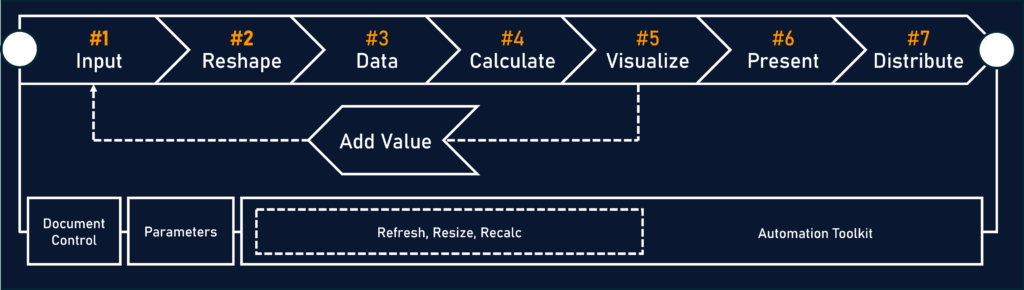
At the centre is the Reporting & Analysis Blueprint, which is a simple seven-step framework for building robust finance processes.
It gives:
- A consistent structure for all reporting
- Clear separation between data, logic, and outputs
- A repeatable way to build processes that don’t break
Reporting & Analysis Blueprint
Learning Programme
Finance Team Accelerator is a structured learning programme:
A clear blueprint – Learn how to design robust finance processes using the Reporting & Analysis Blueprint.
Practical techniques at each stage – Learn the concepts and techniques to create an optimized output for the next step.
Real finance scenarios – Examples and exercises based on real finance tasks, not artificial demonstrations.
Automation without loss of control – Learn how to remove manual steps and create predictable, auditable outputs that are easy to understand.
Sensible use of AI – AI is used where it enhances workflows without introducing additional risk.
What’s included?
Finance Team Accelerator includes:
- 10 × 60‑minute live training sessions
All sessions are recorded and available for replay. - 10 × 30‑minute practical assignments
Designed to reinforce learning by applying concepts to real finance scenarios. - Access to a “How‑to” video library
Step‑by‑step walkthroughs for applying techniques in common scenarios. - Office Hours calls
Dedicated sessions to ask questions, troubleshoot issues, and get practical advice. - 15 Hours of verifiable CPD
Receive a completion certificate to support your CPD requirements.
Syllabus
#1: Reporting & Analysis Blueprint
How to design workflows that don’t break.
#2: Optimal data structure and input control
Build reliable foundations for automation.
#3: Reshape I – Connect, clean and load data
Turn messy inputs into structured data.
#4: Reshape II – Combining dynamic data sources
Create dynamic, connected datasets.
#5: Calculate I – Reusable formula patterns
Simplify calculations with standardized logic.
#6: Calculate II – Get flexible analysis faster
Create flexible data models for faster analysis.
#7: Clear Visual Communication
Create clear, consistent reports that drive better decisions.
#8: Improved insight & reporting
Turn data into meaningful insight and actionable outcomes.
#9: THE ONE CLICK DREAM
Build workflows that run from start to finish with one click.
#10: lasting change
Embed new ways of working across the team.
What do people say about our framework?
“This should be required learning for anyone who has to create repeating reports. It was simply brilliant.”
Charlotte
“The automation framework helped bring together all the disparate best practices and concepts that I had been dancing around.”
Tanya M
The Scope
Any finance task that takes inputs and produces an output fits within the scope of Finance Team Accelerator.
Common tasks include the following:
- Management and board reporting
- Budgeting & forecasting
- Variance analysis
- Reconciliations
- Month-end close processes
- KPI reporting
- Journal preparation
- Exception and anomaly detection
What you build
During the programme, you will build:
- Reliable data pipelines that are easy to maintain
- Automated processes that reduce or eliminate recurring manual steps
- End-to-end reporting workflows that run from input to final output
- A consistent framework you can apply across all reporting tasks
The Tools We’ll Use
Finance Team Accelerator is tool-agnostic, the principles work regardless of the software used.
However, during the programme, we apply the techniques using the tools commonly found in most finance teams.
Core Tools

Excel 365 or Excel 2024 is required to work along with examples and complete exercises.
Excel features covered:
- Modern Functions
- Power Query
- Power Pivot (DAX & Data Model)
- Charts
- Conditional Formatting
- VBA Macros (Optional)
Featured & Optional Extensions




These commonly used tools are featured or used as optional extensions to achieve more.
If users have these tools, it is useful, but not required.
- Power BI (Desktop & Service)
- M365 Copilot
- Power Automate Desktop
- SharePoint
The focus is never on learning software features for their own sake. We use tools to support a better workflow, not the other way around.
Lead Instructor: Mark Proctor
Mark Proctor is an ICAEW Chartered Accountant with more than 25 years’ experience in finance and accounting. He specializes in helping finance teams become more efficient through better workflow design, automation, and data modelling.
Mark is the founder of Excel Off The Grid and has trained thousands of finance professionals around the world.
Credentials and recognition
- Founder of Excel Off The Grid
- Microsoft MVP since 2021
- ICAEW Chartered Accountant
- Regular contributor to the ICAEW Excel Community
- Co-host of the Unpivot Podcast
- Award-winning conference speaker
- Generation CFO Award winner

What difference will it make?
Finance Team Accelerator will transform how your team works.
Before:
- Multiple versions of the same file
- Manual copy-paste workflows
- Errors discovered late
- Heavy reliance on individuals
After:
- Controlled, understandable workflows
- Automated data pipelines
- Reports update with minimal effort
- Shared understanding of processes

Is this right for you?
Finance Team Accelerator is designed for finance professionals who are responsible for recurring reporting, analysis, and control.
It is built to achieve targeted outcomes. Therefore, it is not designed to suit everyone.
Who is it for?
It is suited to the following roles.
- Finance directors
- Heads of finance
- Financial controllers
- FP&A professionals
- Management accountants
- Finance business partners
- Finance managers & team leads
- Senior finance analysts
Who is it not for?
It will not be a good fit for:
- Individuals whose work is almost entirely one-off tasks.
- Anyone who doesn’t want to take accountability for their outputs.
- Those looking for Excel tips, tricks, and shortcuts.
- Anybody who isn’t willing to change how they work.
If you or your team take data from multiple sources and turn it into trusted outputs, then Finance Team Accelerator is built for you.
Is it for the entire team?
In most cases, no.
Mandating change across a whole team rarely works. Lasting improvement comes from individuals choosing to work differently.
The focus is on developing Champions; the people who have both the capability and the desire to improve how work gets done.
Champions begin by transforming their own workflows, then extending to their immediate teams and beyond.
As others see the results, it naturally sparks curiosity. And that curiosity drives wider, voluntary adoption.
This is organic finance transformation from the inside out.
“This is on another level. The blueprint is truly an eye opener and it gives me a clear idea on how to do my work and help others better.”
Roger

Frequently Asked Questions
How can I join Finance Team Accelerator?
Finance Team Accelerator is a cohort-based programme. You can join by either:
- Applying for one of our public cohorts.
- Applying to have the the programme run within your team.
There is more information available on the Apply page.
How quickly can I expect results?
Individuals typically see improvements quickly, especially in:
- Time saved on repetitive tasks
- Reduction in manual steps
- Increased confidence in outputs
However, the real value comes from embedding better practices that continue to deliver benefits long-term. This can take longer depending on the culture, capability, and curiosity of each team.
What level of time commitment is required?
Finance Team Accelerator exists because most finance professionals are already stretched. Therefore, this programme is designed to fit around existing day-to-day work.
For a standard cohort, 90 minutes per week should be sufficient to complete programme:
- 60‑minute live training session (replay available if unable to attend)
- 30-minute assignment
Can I complete the programme faster?
Intensive courses rarely create lasting change. This programme is designed for practical application over time.
Participants need time to understand, think about, and apply the content.
When delivering the Finance Team Accelerator within an organization, we will work with you on timelines to balance speed and delivery.
What if I can’t attend all the live sessions?
Participants will get the most benefit if they attend all the live sessions. But we also appreciate it is not always possible.
Recordings of each live session will be available for replay within 24 hours to enables participants to catch-up on missed sessions.
What happens if I get stuck?
Each week, there are optional Office Hours calls where participants can ask questions and get advice.
Will this work with our existing systems?
Yes.
The programme is designed to work alongside your current systems. The goal is not to replace tools, but to improve the workflows around your existing tools.
Is this just Excel training?
No.
The programme focus is much broader, including:
- Building efficient workflows
- Optimal data structures
- Reusable formula patterns
- Improving reporting and insight
However, because Excel is the most common tool across finance teams, the techniques are primarily applied using Excel. As a result, participants will have significantly stronger Excel skills at the end. But the concepts and frameworks can be applied to other tools; it is not limited to Excel.
Do we need advanced Excel skills?
No.
The programme starts from core principles and builds up the skills to match those principles.
Will we use AI, if so which tools?
Generally, we use AI as a practical tool to:
- Support the building of an efficient workflow.
- Add benefit in key parts of the process where AI is well-suited.
However, there is no requirement to use AI. The overarching blueprint is the same whether AI is used or not.
Where AI is applied, it will use Microsoft 365 Copilot. If participants do not have this available, it will not prevent them from completing the materials.
When running the programme within an organisation we will include/excluded AI tools based on requirements.
How to prevent key person dependency?
Forcing change on people rarely creates good outcomes. Therefore, the focus is on developing a small number of Champions within a team. These are the people who have the capability, capacity, and desire to improve how they and their team work.
Without the right structure in place, this can create key person dependency.
Having multiple Champions in an organization provides multiple benefits:
- Champions support and learn from one another, share ideas, and build momentum as a group.
- Knowledge and improvements are not tied to one individual, but are shared and embedded across individuals.
As Champions start to extend improvements into their immediate teams, their goal is to share knowledge and identify other individuals to develop.
This makes progress more resilient and ensures the mechanism for change continues even if individuals move roles or leave the organization.